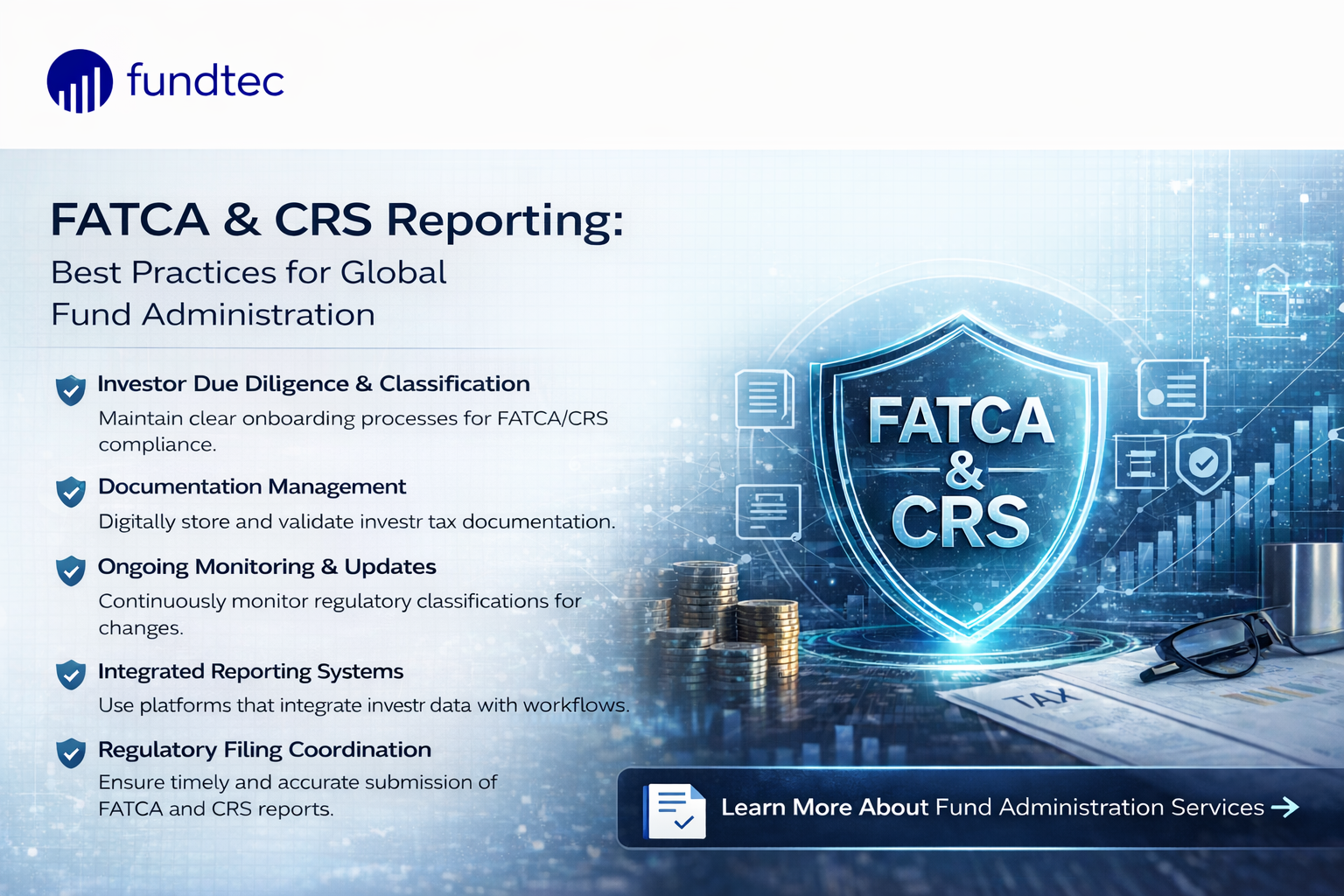
FATCA and CRS reporting is the annual process by which an investment fund identifies investors who are tax resident elsewhere and reports their details and account balances to its local tax authority, which passes them to the investors' home countries. The fund is responsible. In practice the administrator collects investor documentation, classifies accounts and prepares the reports for the fund to file.
For most privately offered funds, this work sits inside investor services and onboarding: the same records used to admit an investor drive the tax classification. This guide explains who does what, how classification works, the filing process and the practices that keep reporting accurate.
What are FATCA and CRS?
FATCA, the US Foreign Account Tax Compliance Act, requires foreign financial institutions, which include most offshore investment funds, to identify US persons among their account holders and report them. CRS, the OECD Common Reporting Standard, applies the same idea across more than 100 participating jurisdictions: funds report account holders who are tax resident in other participating countries.
For a fund, both regimes mean the same four tasks: identify reportable investors, collect and validate self-certifications, classify entity investors correctly, and file an annual report with the authority of the fund's domicile.
Who handles fund-level tax and investor-level regulatory reporting?
Responsibility stays with the fund and its board, but the work is shared. The table below shows a typical split for an offshore private fund.
| Party | Typical responsibility |
|---|---|
| Fund and its directors or general partner | Legal responsibility for registration, accurate reporting and filing |
| Fund administrator | Collects self-certifications, validates them, classifies accounts, maintains records and prepares the reports |
| Tax adviser | Advises on the fund's own classification and on complex investor cases |
| Fund counsel | Advises on local registration and filing obligations in each domicile |
| AML compliance officer | Aligns tax documentation with KYC and AML records |
| Investor | Provides a valid self-certification and updates it when circumstances change |
Fund-level tax, such as the fund's own tax returns or partner-level K-1 data for a US partnership, is a separate workstream. An administrator usually provides the books and data; the fund's tax preparer prepares and signs the returns.
How is an investor classified for FATCA and CRS?
Classification starts at onboarding, from the self-certification form each investor completes alongside the subscription documents.
- Collect the self-certification. Individuals give their tax residence and taxpayer identification numbers. Entities give their FATCA and CRS status.
- Check reasonableness. Compare the self-certification with the KYC file: address, place of incorporation, controlling persons. Conflicts must be resolved before the account is treated as documented.
- Classify the account. Decide whether the account is reportable under FATCA, CRS or both, and for which jurisdictions.
- Look through passive entities. For a passive non-financial entity, identify its controlling persons and classify them too.
- Record and monitor. Store the evidence and flag any change in circumstances, such as a new address in another country, for a fresh self-certification.
What does the annual filing process look like?
The filing cycle repeats every year and runs to the deadlines of the fund's domicile, which differ by jurisdiction and are commonly in the middle of the year. In Ireland, for example, reporting financial institutions file through Irish Revenue's online system; Cayman and BVI funds file through their own government portals. Confirm current deadlines with counsel.
- Confirm the fund's registration status and GIIN for FATCA.
- Freeze the reportable population at year end and refresh any missing or expired self-certifications.
- Extract year-end balances, and income or gross proceeds where required, for each reportable account.
- Build the report in the authority's required format and validate it.
- Review and approve, with the fund's sign-off.
- File, keep the acknowledgement and correct any rejected records.
What does FATCA and CRS classification look like? A worked example
Here is an illustrative example. A Cayman fund has 40 investors at year end.
| Investor group | Count | Classification | Reported to |
|---|---|---|---|
| Non-US individuals resident in the EU | 18 | CRS reportable | Cayman authority, for exchange with each country |
| US individuals | 6 | FATCA reportable | Cayman authority, for exchange with the US |
| Financial institutions (funds of funds, banks) | 9 | Not reportable as account holders | None |
| Passive entities with controlling persons in the UK | 4 | CRS reportable through controlling persons | Cayman authority, for exchange with the UK |
| Investors with missing or conflicting documents | 3 | Undocumented until resolved | Followed up before the filing deadline |
The administrator chases the three incomplete files in the first quarter, so every account is documented before the report is built. Every figure here is illustrative.
What are the best practices for FATCA and CRS reporting?
- Make tax documentation part of onboarding. No subscription should be accepted without a valid self-certification.
- Keep one investor record. KYC, tax status and account data should sit in the same system, so a change in one updates the others.
- Monitor changes in circumstances. A new address or nationality can change classification mid-year.
- Validate before filing. Check TIN formats, missing fields and controlling persons before the deadline, not after a rejection.
- Document every decision. Keep the reason for each classification so it can be explained to an auditor or regulator.
- Agree responsibilities in writing. The service agreement should say who prepares, who reviews and who files.
Where does Fundtec fit?
Fundtec prepares the data and reports for FATCA and CRS as part of investor services for privately offered funds. That covers self-certification collection and validation, classification and report preparation, with the fund, its directors or its compliance adviser remaining responsible for submission and sign-off where the rules require it. Fundtec is not a tax adviser. Work is delivered with 24/5 coverage under ISO 27001 and ISO 9001 certified controls.
Accurate tax reporting is a by-product of accurate investor records. To see how onboarding, KYC and tax documentation run together, read about our fund investor services.
Frequently asked questions
Who handles fund-level tax and investor-level regulatory reporting?
The fund and its directors or general partner are legally responsible. In practice, the administrator collects and validates investor self-certifications, classifies accounts and prepares FATCA and CRS reports, while the fund's tax adviser and counsel advise on classification and filing obligations. Fund-level tax returns and partner K-1s are prepared by the fund's tax preparer using data from the administrator.
What is the difference between FATCA and CRS?
FATCA is a US regime that requires foreign financial institutions to report accounts held by US persons. CRS is the OECD standard used by more than 100 jurisdictions to report accounts held by residents of other participating countries. Funds usually collect one self-certification that covers both, then classify each account under each regime.
How do FATCA and CRS filings work for an Irish fund?
Irish funds that are reporting financial institutions file FATCA and CRS returns with Irish Revenue through its online system, using the format Revenue prescribes, by the annual deadline Revenue sets. The administrator typically prepares the return from validated investor records and the fund approves it. Confirm current deadlines and registration details with Irish counsel or your tax adviser.
What happens if an investor does not provide a self-certification?
The account cannot be treated as documented. The fund should not accept the subscription without one, and for existing accounts it should follow up promptly and apply the fallback procedures the rules set out. Missing documentation is one of the most common reasons for late or incorrect reports.
Does a fund administrator file FATCA and CRS reports?
Often the administrator prepares the reports and may submit them on the fund's behalf, but legal responsibility stays with the fund. The service agreement should state clearly who prepares, who reviews, who approves and who submits each filing, so nothing is missed at the deadline.